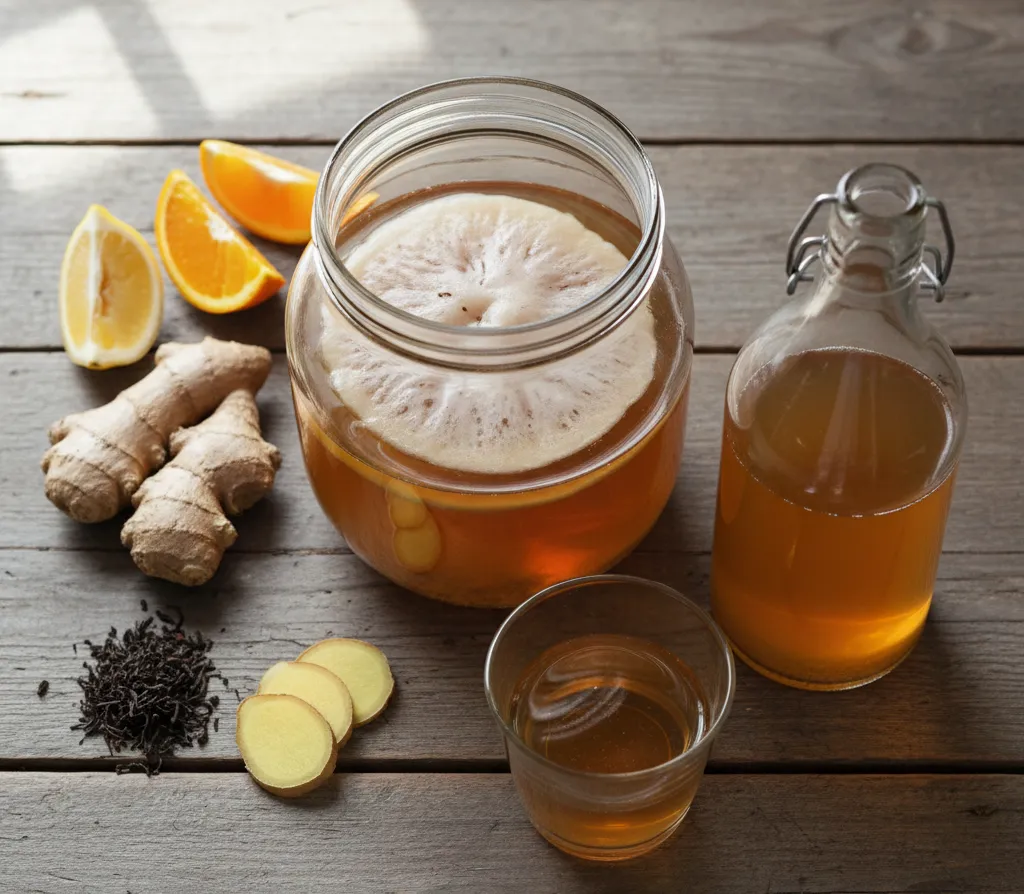
What’s actually in kombucha?
During fermentation, the SCOBY’s bacterial and yeast culture transforms the sugar in the tea into a complex drink that contains:
Organic acids
Mainly acetic acid, with smaller amounts of lactic acid and gluconic acid — these give the characteristic tangy taste.
Live microorganisms
Mainly acetic acid bacteria and yeasts, if the drink isn't pasteurized.
Trace alcohol
Typically under 0.5% in home brews. More on alcohol content →
Residual sugar
Depends on fermentation length — the longer it ferments, the less sugar remains.
Caffeine
Amount depends on the tea used.
What does research say about the probiotic effect?
The term “probiotic” refers to live microorganisms that, when consumed in adequate amounts, may provide a health benefit. Kombucha genuinely does contain live cultures — that’s a scientifically supported fact.
What’s less clear is whether these cultures survive the stomach-acid environment in numbers large enough to produce a clinically measurable effect on the gut microbiome. This is still an actively developing area of research — a significant portion of studies so far have been animal studies or small human trials; large, well-controlled human clinical trials specifically on kombucha are still limited.
Sugar content — worth paying attention to
The final product’s sugar content depends heavily on fermentation length and F2 flavoring.
Can contain significant residual sugar — nearly as much as a soda.
Can be low in sugar by comparison.
If you’re watching your sugar intake:
Who should avoid it, or be cautious?
Because of the trace alcohol content and unpasteurized live cultures, certain groups should check with a doctor before consuming it regularly.
Safe consumption when home-brewing
Since there’s no industrial quality assurance at home, safe consumption largely comes down to careful preparation: clean equipment, the right temperature, and regularly checking your SCOBY — more on this on our Caring for your SCOBY page.
Summary
Kombucha can be a nutritious, low-calorie alternative to sweetened soft drinks, and contains compounds with scientific backing for potential health benefits — but research in this area is still in an early stage, and “miracle cure” claims aren’t currently supported by adequate evidence. It’s worth consuming with realistic expectations and in moderation, as part of an otherwise varied diet.